Urdu Transliteration vs Urdu Translation: What’s the Difference?
Urdu is widely used in Pakistan and by Urdu-speaking communities around the world. When people want to use Urdu text on websites, social media, mobile applications, or digital documents, they often need to convert it into English letters.
This is where two commonly confused terms come in: Urdu transliteration and Urdu translation.
Although both involve Urdu and another writing format or language, they serve different purposes. Understanding the difference can help you choose the right tool.
What Is Urdu Transliteration?
Urdu transliteration means writing Urdu words using the English alphabet (Roman letters) while keeping their original pronunciation as closely as possible.
For example:
- آپ کیسے ہیں؟ → Aap Kaise Hain?
- میرا نام علی ہے۔ → Mera Naam Ali Hai.
- پاکستان زندہ باد → Pakistan Zindabad
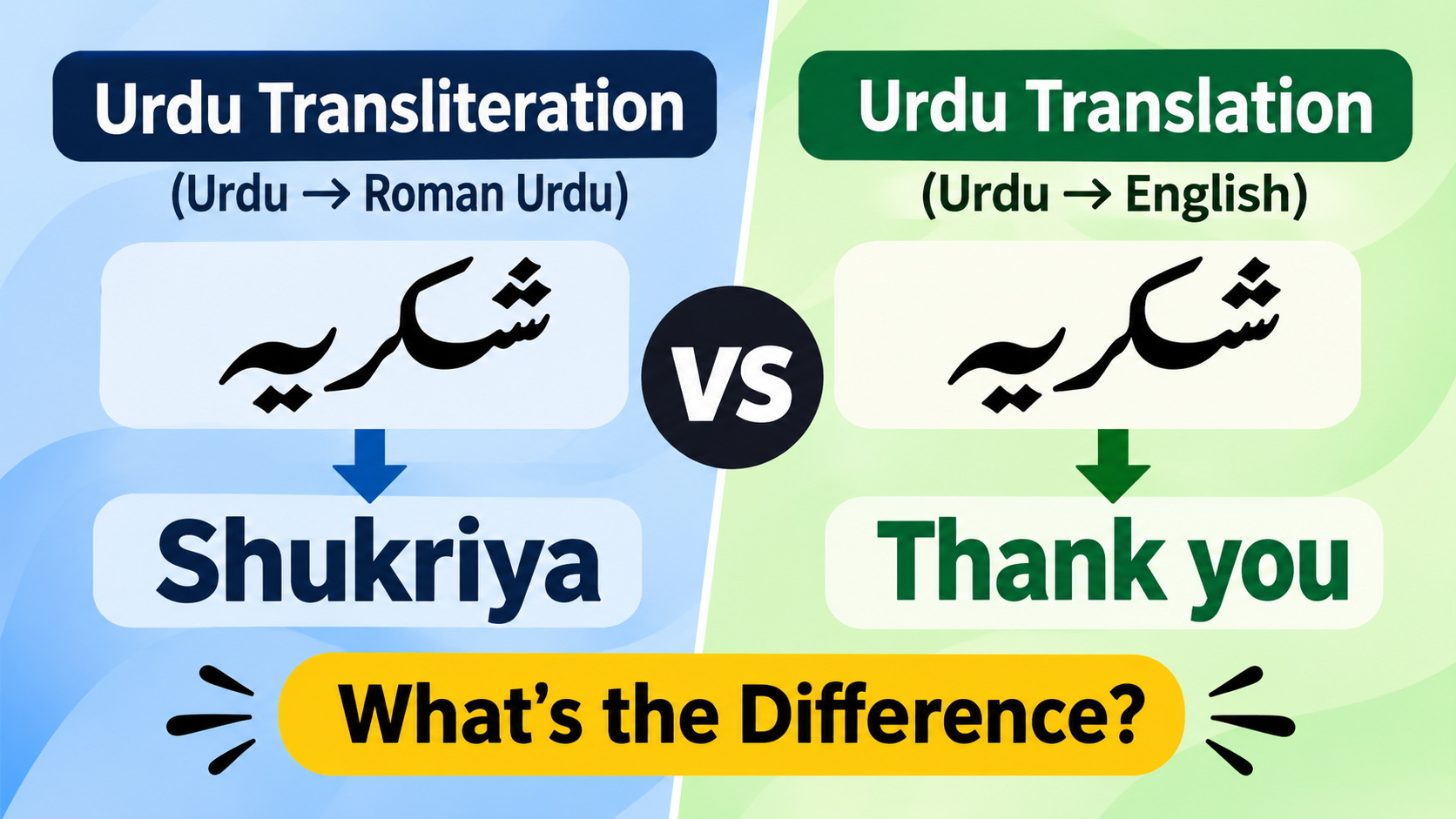
- شکریہ → Shukriya
The meaning of the original Urdu text stays the same. Only its writing system changes.
Roman Urdu is commonly used in text messages, social media comments, online conversations, and digital forms.
What Is Urdu Translation?
Urdu translation means converting the meaning of Urdu text into another language, such as English.
For example:
- آپ کیسے ہیں؟ → How are you?
- میرا نام علی ہے۔ → My name is Ali.
- شکریہ → Thank you.
- مجھے اردو پسند ہے۔ → I like Urdu.
Unlike transliteration, translation changes the language while preserving the meaning.
Urdu Transliteration vs Urdu Translation
Here is a simple comparison:
| Feature | Transliteration | Translation |
| Main purpose | Changes the writing system | Changes the language |
| Original pronunciation | Generally preserved | Not necessarily preserved |
| Output | Urdu written in Roman letters | Meaning expressed in another language |
| Example | شکریہ → Shukriya | شکریہ → Thank you |
When Should You Use Urdu Transliteration?
Urdu transliteration is useful when you want to write Urdu words using English letters without translating their meaning.
Common use cases include:
- Writing Urdu messages using an English keyboard.
- Converting Urdu names into Roman letters.
- Writing addresses in English letters.
- Preparing Urdu text for digital forms.
- Creating Roman Urdu content for websites and social media.
- Converting multiple Urdu sentences into Roman Urdu.
For names and addresses, transliteration can be particularly useful. However, official spellings should always be checked against identity documents or other authoritative records.
How to Convert Urdu Text into Roman Urdu Online
You can use an online Urdu transliteration tool to convert Urdu text into Roman Urdu.
Try the free ToolsVexa Urdu to Roman Urdu Converter:
https://toolsvexa.com/tools/roman-urdu-transliteration
Follow these steps:
- Open the Urdu to Roman Urdu Converter.
- Enter or paste your Urdu text.
- View the Roman Urdu result.
- Copy the converted text.
- For multiple entries, use the bulk conversion option.
The tool also supports Sindhi transliteration, multiple lines, TXT/CSV uploads, and CSV downloads.
Can Urdu Transliteration Be 100% Accurate?
Urdu transliteration can sometimes produce different Roman spellings for the same word. This happens because Roman Urdu does not have one universally accepted spelling standard.
For example, a word may be written in more than one way depending on pronunciation and personal preference.
Names, regional words, and unusual spellings may also require manual review. For important documents, always verify the final spelling before using it.
Final Thoughts
Urdu transliteration and Urdu translation are different processes. Transliteration changes Urdu writing into Roman letters while keeping the original language, whereas translation expresses the meaning in another language.
If you want to write Urdu text using English letters, transliteration is the right choice.
Use the free ToolsVexa Urdu to Roman Urdu Converter to convert Urdu text, names, addresses, and multiple lines into Roman Urdu online.