MD5 vs SHA-256: Differences, Security, and Which Hash to Use
MD5 vs SHA-256 is a common comparison in cybersecurity, software development, and data integrity. Both are cryptographic hash algorithms that convert input data into fixed-length hash values. However, they differ in security, output length, performance, and practical applications.
If you are researching MD5 vs SHA-256, trying to understand password hashes, or looking for information about a password hash generator, this guide explains everything you need to know.
In this guide, we will compare both algorithms, explain their security differences, explore common use cases, and help you understand which hashing algorithm is suitable for different applications.
What Is MD5 Hashing?
MD5 stands for Message Digest Algorithm 5. It is a cryptographic hash function developed by Ronald Rivest in 1991.
MD5 accepts input data of different lengths and generates a fixed 128-bit hash value, usually displayed as 32 hexadecimal characters.
Example:
- Original Text: Hello World
- MD5 Hash:
b10a8db164e0754105b7a99be72e3fe5
MD5 was widely used for file checksums, data verification, and older software applications. However, security researchers discovered weaknesses that make it vulnerable to practical collision attacks.
A collision happens when two different inputs produce the same hash value. For this reason, MD5 is no longer recommended for security-sensitive applications.
Common Applications of MD5
- Legacy software compatibility.
- Non-security-sensitive file identification.
- Basic checksums for accidental data corruption detection.
- Existing systems that require MD5 compatibility.
MD5 should not be used for password storage, digital signatures, or security-sensitive integrity verification.
What Is SHA-256?
SHA-256 stands for Secure Hash Algorithm 256-bit. It belongs to the SHA-2 family of cryptographic hash functions.
SHA-256 processes input data and generates a fixed-length 256-bit digest represented by 64 hexadecimal characters.
Example:
- Original Text: Hello World
- SHA-256 Hash:
a591a6d40bf420404a011733cfb7b190d62c65bf0bcda32b57b277d9ad9f146e
SHA-256 provides significantly stronger collision resistance than MD5 and is widely used in modern cryptographic applications.
Common Applications of SHA-256
- File integrity verification.
- Digital signature systems.
- Blockchain technologies.
- HMAC-based message authentication.
- Software package verification.
- Cryptographic data fingerprinting.
SHA-256 is generally a better choice than MD5 when developing new security-sensitive applications.
MD5 vs SHA-256: Key Differences
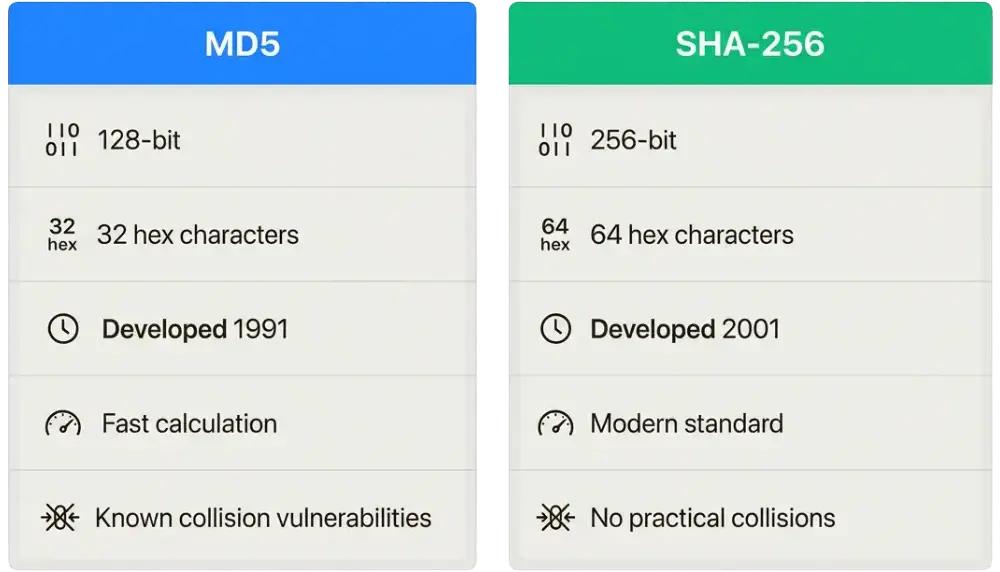
The following table highlights the major differences between MD5 and SHA-256.
| Feature | MD5 | SHA-256 |
| Full Name | Message Digest 5 | Secure Hash Algorithm 256 |
| Algorithm Family | MD | SHA-2 |
| Output Size | 128 bits | 256 bits |
| Hash Length | 32 characters | 64 characters |
| Security | Cryptographically broken | Strong collision resistance |
| Performance | Generally faster | Generally slower |
| Collision Resistance | Weak | Strong |
| Password Storage | Not recommended | Not recommended alone |
| Modern Security Applications | Not recommended | Recommended for suitable cryptographic uses |
The biggest difference is security. SHA-256 offers substantially stronger collision resistance and is suitable for many modern cryptographic applications.
MD5 vs SHA256 Security: Which Is Safer?
When comparing MD5 vs SHA256 security, SHA-256 is the clear winner.
MD5 has known weaknesses that allow attackers to generate different files with identical hash values under certain conditions. This makes it unsuitable for applications where attackers may manipulate data.
SHA-256 provides much stronger collision resistance. No practical collision attack against the full SHA-256 algorithm is currently known.
However, SHA-256 does not protect every application automatically. Developers must use it correctly and select the appropriate security mechanism for their requirements.
MD5 Password Generator: What Does It Mean?
An MD5 password generator converts a text input into an MD5 hash.
For example, a user may enter a text string, and the hashing algorithm produces a 32-character hexadecimal digest.
However, an MD5 password hash should not be confused with secure password storage.
MD5 is extremely fast, which makes it easier for attackers to test large numbers of password guesses.
For this reason, MD5 should not be used to store user passwords.
What Is a Password Hash Generator?
A password hash generator converts input text into a fixed-length hash using a selected hashing algorithm.
Common hashing algorithms include:
- MD5
- SHA-1
- SHA-256
- SHA-512
These algorithms produce different hash lengths and have different security properties.
A password hash generator may be useful for learning about hashing and understanding how different algorithms produce different outputs. However, generating a plain MD5 or SHA-256 hash is not the same as securely storing a password.
For password storage, dedicated algorithms such as Argon2id, bcrypt, scrypt, and PBKDF2 are recommended.
Try an Online Password and Hash Generator
If you want to experiment with different hashing algorithms, you can use the ToolsVexa Password and Hash Generator.
It supports MD5, SHA-1, SHA-256, SHA-384, SHA-512, and HMAC hashing. You can enter text or select a file to calculate hash values and compare their outputs.
The tool also includes a password generator for creating random passwords. Its operations run in your browser, so the text and files you process are not uploaded to the website.
Remember that plain MD5 and SHA-256 hashes are useful for learning and testing, but they are not recommended for secure password storage.
Why Are MD5 and SHA-256 Hashes Different in Length?
MD5 generates a 128-bit digest, whereas SHA-256 generates a 256-bit digest. This results in different hexadecimal output lengths.
| Algorithm | Bits | Hexadecimal Characters |
| MD5 | 128 | 32 |
| SHA-1 | 160 | 40 |
| SHA-256 | 256 | 64 |
| SHA-512 | 512 | 128 |
Each hexadecimal character represents four bits. Therefore, a 256-bit SHA-256 digest requires 64 hexadecimal characters.
Is Hashing the Same as Encryption?
No. Hashing and encryption are two different concepts.
Hashing
- Designed as a one-way operation.
- Produces a fixed-length digest.
- Does not require a decryption key.
- Commonly used for integrity verification.
Encryption
- Converts readable data into ciphertext.
- Can be reversed using the appropriate decryption key.
- Used to protect confidential information.
MD5 and SHA-256 are hashing algorithms, not encryption algorithms.
Can MD5 or SHA-256 Be Reversed?
MD5 and SHA-256 are designed to be one-way hash functions. Their original input cannot normally be recovered directly from the hash.
However, attackers can try possible inputs and compare their resulting hashes against a known value. This technique is particularly effective against weak or predictable passwords.
A cryptographic hash should therefore not be considered a substitute for proper password protection.
Which Hash Algorithm Should You Choose?
Your choice depends on the application.
| Requirement | Recommended Approach |
| Legacy MD5 compatibility | MD5 |
| Modern file integrity verification | SHA-256 |
| Digital signatures | SHA-256 within an appropriate signature scheme |
| Password storage | Argon2id or bcrypt |
| Message authentication | HMAC-SHA-256 |
| Learning about hash functions | MD5 and SHA-256 comparisons |
For new security-sensitive applications, SHA-256 is generally preferable to MD5.
For password storage, use a dedicated password-hashing algorithm rather than either plain MD5 or plain SHA-256.
Frequently Asked Questions
Is MD5 better than SHA-256?
No. SHA-256 offers significantly stronger collision resistance and is more suitable for modern cryptographic applications. MD5 has known security weaknesses and should only be used for legacy compatibility or non-security-sensitive purposes.
What Is the Main Difference Between MD5 and SHA-256?
The main difference is their output size and security. MD5 generates a 128-bit hash with 32 hexadecimal characters, while SHA-256 generates a 256-bit hash with 64 hexadecimal characters. SHA-256 provides much stronger security against collision attacks.
Is an MD5 Password Generator Safe to Use?
An MD5 password generator can be used for learning, testing, and legacy compatibility. However, MD5 is not safe for storing user passwords because it is extremely fast and vulnerable to attacks. Use Argon2id, bcrypt, scrypt, or PBKDF2 for secure password storage.
What Is a Password Hash Generator Used For?
A password hash generator converts text into a fixed-length hash using algorithms such as MD5, SHA-1, SHA-256, or SHA-512. It is useful for testing, learning about hashing, and comparing hash outputs. However, a basic hash generator is not a replacement for secure password storage.
Does SHA-256 Always Generate the Same Hash?
Yes. SHA-256 is deterministic, which means the same input data produces the same hash when processed using the same encoding. Even a small change in the input usually produces a completely different hash.
How Long Is an MD5 Hash?
An MD5 hash is 128 bits long and is normally represented by 32 hexadecimal characters.
How Long Is a SHA-256 Hash?
A SHA-256 hash is 256 bits long and is normally represented by 64 hexadecimal characters.
Is SHA-256 Used in Blockchain?
Yes. SHA-256 is used in several blockchain technologies. Bitcoin, for example, uses SHA-256 as part of its proof-of-work mechanism and other cryptographic operations.
Can You Decrypt an MD5 or SHA-256 Hash?
No. MD5 and SHA-256 are one-way hashing algorithms, so their hashes cannot be directly decrypted to recover the original input. However, someone can test possible inputs and compare their resulting hashes to identify a matching value.
Which Hash Algorithm Should I Use for Passwords?
For password storage, use a dedicated password-hashing algorithm such as Argon2id, bcrypt, scrypt, or PBKDF2. Avoid storing passwords using plain MD5 or SHA-256 because these algorithms are not designed to protect passwords against large-scale guessing attacks.
Is SHA-256 Suitable for File Verification?
Yes. SHA-256 is commonly used to verify file integrity. You can calculate a file's SHA-256 hash and compare it with a trusted reference hash to check whether the file has changed. However, the reference hash must come from a trustworthy source.